
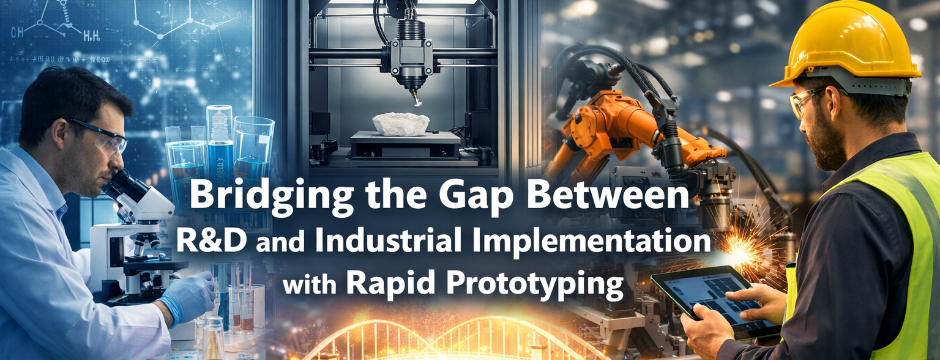
Research and development often produce strong ideas, detailed designs, and promising concepts. However, turning those ideas into real products that work in the field is not always simple. Many organizations face a gap between laboratory innovation and large-scale industrial use. Designs that look promising on paper may reveal practical challenges when they are built and tested.
This is where rapid prototyping becomes valuable. By building working models early in the process, teams can test ideas, improve designs, and verify performance before committing to large production runs. Rapid prototyping services allow engineers and product teams to move from theory to real-world testing quickly and with less risk.
Today, many industries rely on Industrial Rapid Prototyping to bring new technologies to market faster. From energy systems and manufacturing equipment to advanced materials and automation systems, prototypes help bridge the gap between research and practical deployment.
The Gap Between Research and Industrial Use
Research projects often focus on scientific validation or early technical feasibility. Engineers develop models, simulations, and theoretical designs to prove that a concept works. These steps are essential, but they do not always reveal how a system behaves in real operating conditions.
Industrial environments present different challenges. Equipment must handle continuous operation, changing temperatures, mechanical stress, and real production demands. Even small design issues can create problems when a system moves from the lab to a factory or processing facility.
Common challenges during this transition include:
- Mechanical parts that behave differently under load
- Material limitations that were not visible during early design
- Assembly challenges during fabrication
- Integration issues between mechanical and electrical components
- Unexpected performance variations during long operating cycles
Without physical testing, these problems may only appear after production begins. Fixing them at that stage can be expensive and time-consuming.
Rapid prototyping in manufacturing helps prevent this situation. By creating functional prototypes early, teams can identify weaknesses, refine the design, and improve reliability before full production begins.
The Role of Rapid Prototyping in Modern Engineering
Rapid prototyping allows engineers to build physical versions of a design in a short period of time. Instead of waiting for full manufacturing setups, prototypes can be produced using flexible fabrication methods such as additive manufacturing, CNC machining, or hybrid fabrication processes.
This approach allows teams to evaluate key design factors such as:
- Structural strength
- Assembly fit and alignment
- Component interaction
- Thermal behavior
- Fluid movement in process systems
When engineers can physically test a design, they gain insight that simulations alone cannot provide.
Industrial Rapid Prototyping also supports faster design cycles. If a problem is discovered during testing, the design can be updated and a new prototype can be produced quickly. This process allows engineers to refine systems step by step until the design performs as intended.
3D Printing for Prototyping and Design Validation
One of the most widely used tools in rapid prototyping today is 3D printing for prototyping. This technology allows engineers to build complex parts directly from digital models without the need for traditional tooling.
3D printing offers several advantages during the early stages of product development.
First, it allows complex shapes and internal structures to be produced easily. Many industrial systems require detailed geometries that are difficult to manufacture using conventional methods during early development.
Second, 3D printing allows engineers to test multiple design variations quickly. If a component needs adjustment, the digital model can be modified and printed again in a short time.
Third, it reduces the cost of experimentation. Instead of building expensive molds or tooling for early tests, prototypes can be produced with minimal setup.
Because of these benefits, 3D Printing for Prototyping has become an essential tool for many engineering teams working on new technologies.
Product Development Prototyping in Industrial Innovation
Product development prototyping is not limited to testing a single component. In many cases, entire assemblies or systems must be evaluated before production begins.
For example, a new industrial process unit may require testing of several elements at once:
- Mechanical structures
- Fluid flow channels
- Control components
- Heat management systems
Testing these elements together helps engineers understand how the full system behaves.
Product Development Prototyping allows teams to simulate real operating conditions before committing to full manufacturing. Engineers can examine how components interact, how the system performs under load, and whether the design meets its intended goals.
This approach reduces uncertainty during the development process. It allows organizations to move forward with confidence when the time comes to build production systems.
Rapid Prototyping in Manufacturing and Process Systems
Manufacturing environments require reliable equipment and stable processes. Machines must run continuously, and unexpected downtime can lead to production delays and financial loss.
Rapid prototyping in manufacturing helps address these concerns before systems reach the factory floor.
By building and testing prototypes of machinery, tools, or process units, engineers can confirm that the design works under realistic conditions. Mechanical movement, vibration, and operational loads can be evaluated before final fabrication begins.
This step is especially valuable when designing new equipment or modifying existing production systems.
Prototypes also help manufacturing teams prepare for installation and assembly. Engineers can verify that components fit together correctly and that maintenance access is practical. Small improvements at this stage can prevent large operational issues later.
Reducing Risk During Technology Commercialization
Moving a technology from research to commercial use involves both technical and financial risk. Without careful testing, organizations may invest heavily in systems that require costly redesigns.
Rapid prototyping services reduce this risk by allowing early validation of design assumptions.
Testing prototypes helps confirm whether a system can:
- Withstand operating loads
- Maintain stable performance
- Integrate with existing equipment
- Operate safely in real environments
If problems appear, they can be addressed before major investments are made.
This validation process helps companies avoid delays and unexpected costs during production deployment.
Supporting Collaboration Between Engineering Teams
Industrial product development often involves multiple teams. Mechanical engineers, electrical engineers, materials specialists, and operations teams may all contribute to a project.
Prototypes help these teams communicate more effectively.
A physical model allows engineers and stakeholders to see how a system works. Instead of relying only on drawings or digital models, teams can examine actual components and identify areas for improvement.
Rapid prototypes also support field testing and demonstration. Organizations can evaluate equipment in controlled environments and collect performance data before launching full production.
This collaborative process leads to better design decisions and smoother implementation.
The Importance of Iteration and Continuous Improvement
One of the most important benefits of rapid prototyping is the ability to improve designs through iteration.
Rarely does a complex industrial system reach perfection in the first design attempt. Testing often reveals areas that require adjustment. Components may need stronger materials, improved alignment, or better heat management.
With rapid prototyping, these improvements can be implemented quickly.
Engineers update the design, produce a new prototype, and repeat testing until the system performs reliably. Each cycle brings the product closer to its final production form.
This iterative approach supports innovation while maintaining practical engineering discipline.
TechUrja and the Path from Concept to Implementation
At TechUrja, we support organizations in transforming early ideas into functional systems through advanced rapid prototyping services. Our work focuses on building and testing prototypes that reflect real industrial conditions. By combining engineering design, material selection, and practical fabrication methods, we help clients move from research concepts to reliable operational systems. Our approach to Industrial Rapid Prototyping supports faster validation, better design decisions, and smoother transition into manufacturing environments.
The Future of Rapid Prototyping in Industrial Development
The importance of rapid prototyping will continue to grow as industries pursue new technologies and more efficient production systems. Innovations in materials, additive manufacturing, and digital design tools are making prototypes more accurate and easier to produce.
These advances allow engineers to test complex systems earlier in the development process. Prototypes are no longer limited to simple models. Today they can closely resemble final products in both structure and performance.
As a result, companies can refine designs more effectively before committing to full production infrastructure.
Industrial sectors such as energy systems, automation equipment, advanced materials, and environmental technologies are already benefiting from these improvements.
Organizations that adopt rapid prototyping as part of their product development strategy often achieve faster innovation cycles and more reliable outcomes.
Conclusion
Turning research ideas into real industrial systems requires more than theoretical design. It requires physical validation, practical testing, and careful refinement. Rapid prototyping provides the tools needed to make this transition successful.
Through rapid prototyping services, engineers can test designs, detect weaknesses, and refine systems before large production investments begin. Industrial Rapid Prototyping enables teams to move from concept to implementation with greater confidence and lower risk.
Technologies such as 3D Printing for Prototyping and modern fabrication methods make it possible to build and test complex components quickly. When combined with Product Development Prototyping and iterative testing, these tools help ensure that new technologies are ready for real-world use.
Rapid prototyping in manufacturing has become a critical step in modern engineering. By bridging the gap between research and industrial implementation, it allows organizations to turn innovative ideas into reliable, production-ready solutions.
Frequently Asked Questions
- What are rapid prototyping services?
Rapid prototyping services involve creating physical models or early versions of a product quickly using modern fabrication methods such as 3D printing, CNC machining, or hybrid manufacturing. These prototypes allow engineers to test design concepts, evaluate performance, and refine systems before moving to full-scale production.
- Why is Industrial Rapid Prototyping important for product development?
Industrial Rapid Prototyping helps companies verify whether a design will perform reliably in real operating conditions. By testing prototypes early, engineers can identify weaknesses, improve functionality, and reduce the risk of costly design changes during large-scale manufacturing.
- How does 3D printing help in rapid prototyping?
3D Printing for Prototyping allows engineers to build complex parts directly from digital designs without the need for specialized tooling. This makes it possible to produce prototypes quickly, test multiple design variations, and make adjustments faster during the development process.
- What is the role of prototyping in manufacturing projects?
Rapid Prototyping in Manufacturing helps engineers evaluate machinery components, system assemblies, and production equipment before final fabrication. This process ensures that the design works properly, components fit together correctly, and the system performs well under real operating conditions.
- How does product development prototyping reduce project risk?
Product Development Prototyping allows teams to test and refine designs before committing to full production. By validating performance, materials, and system integration early in the process, organizations can avoid expensive redesigns, prevent operational issues, and bring reliable products to market more efficiently.