
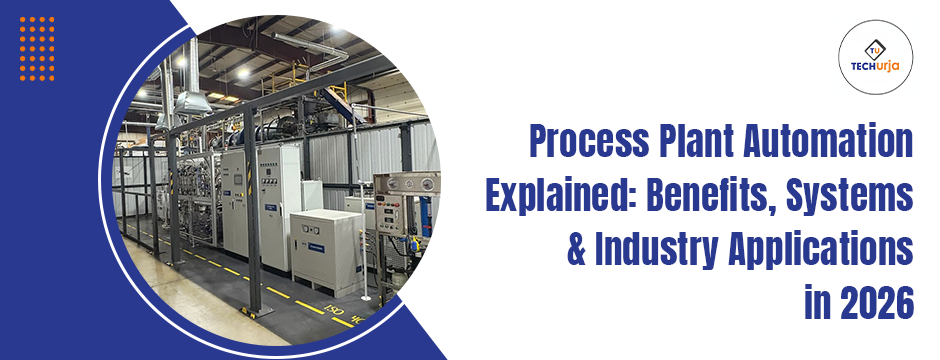
Process plant automation has become a critical driver of proficient, secure, and scalable manufacturing and has become more of a requirement than an option for the process industries as they move into 2026, facing higher operational costs, labour shortages, increased compliance, and quality demands.
Automated process plants found in industries such as chemical, oil and gas, food, and pharmaceuticals utilize sophisticated systems that control complex processes with little interaction from people. By collecting data in real-time, these advanced control systems are able to monitor variables such as pressure, temperature, flow rate, and chemical composition and provide a means to optimize performance while minimizing mistakes and downtime.
Additionally, the speed of development associated with Industry 4.0 technologies, including IIoT, AI, machine learning, and advanced analytics, has greatly increased the speed at which industries are adopting automation for their processes. Process plants are becoming smarter, more connected, and more responsive, with capabilities for predictive maintenance, energy management, and remote control.
This blog will define plant automation, describe its benefits and the systems that make plant automation work, and discuss how different industries will utilize plant automation in 2026 to remain competitive, compliant, and ready for the future.
What Is Process Plant Automation
It refers to using control systems, instrumentation, and computer software to operate an industrial process with little or no human intervention. Discrete manufacturers generally produce discrete products one product at a time, whereas process automation processes that produce continuous and/or batch processes involving the processing of materials that undergo chemical, physical, and/or biological changes during the production of a product.
Automated processes continually monitor the process variables and automatically adjust them to produce a minor adjustment for greater stability, efficiency, and safety. There is a central control room that controls the processes. The operator of the central control room only intervenes when an issue occurs with the automation of the processes.
Major Advantages of Plant Automation in 2026
Improved Operational Efficiency
Automation eliminates the need for manual labor and optimizes process conditions to maintain a constant level of performance. The use of advanced control strategies allows plants to produce at their highest capacity level while generating minimal waste and using less energy.
Enhanced Safety and Risk Reduction
Automated processes provide less human interaction in potentially dangerous working environments by utilizing Safety Instrumented Systems (SIS) and emergency shutdown devices that can react to any anomalies by immediately halting operations and preventing possible accidents or damage to equipment.
Higher Product Quality and Consistency
Automation controls variable process ranges, allowing for consistency of quality in products produced. It also reduces the occurrence of human error, making it much easier to comply with the many quality standards and regulations that are in place.
Core Systems Used in Process Plant Automation
Distributed Control Systems (DCS)
DCS is used for large-scale process automation. They provide decentralized control of several processes in a facility and enable centralized monitoring and control through a network of distributed controllers.
Programmable Logic Controllers (PLCs)
PLCs are typically used to control one specific process or piece of equipment and are a fast and reliable way to control many processes or pieces of equipment. Modern plants use PLCs as part of DCS and SCADA systems.
Supervisory Control and Data Acquisition (SCADA)
SCADA systems collect data from sensors and controllers, providing operators with real-time visibility, alarms, and historical data analysis.
Safety Instrumented Systems (SIS)
SIS are safety instruments that provide an independent layer of safety to detect hazardous conditions and automatically bring a process to a safe condition.
Industrial IoT and Advanced Analytics
Industrial Internet of Things (IIoT) and advanced analytics provide real-time visibility of the plant through IIoT devices, cloud platforms, and AI-based analytics to allow remote monitoring and real-time, intelligent decision-making.
Industry Applications of Industrial Automation Systems
Oil and Gas
Automation allows for the safe drilling, efficient refining, and reliable monitoring of pipelines, while also providing upstream/midstream/downstream operations with an ability to comply with environmental standards.
Chemical and Petrochemical Plants
Highly complex and hazardous processes require precise control. Industrial automation systems improve reaction consistency, reduce waste, and enhance safety.
Food and Beverage Manufacturing
Automated processes in food and beverage production provide traceability, cleanliness, and a high level of product quality while also ensuring compliance with food safety standards.
Pharmaceuticals and Life Sciences
Process automation ensures compliance with regulatory requirements (FDA/GMP) while providing manufacturers with accurate and consistent batch control through comprehensive data collection in preparation for future audits and quality assurance programs.
Power Generation and Utilities
Automation improves the ability of power generation facilities to efficiently generate electricity, provide grid stability, treat water to potable standards, and deliver energy to customers. Automation also aids in predictive maintenance of equipment.
Process Control Automation Trends Shaping 2026
- AI-driven process optimization for real-time decision-making
- Digital twins for simulation and performance improvement
- Cybersecurity-focused automation architectures
- Remote and autonomous plant operations
- Sustainability-driven automation to reduce emissions and energy use
These trends are transforming traditional plants into intelligent, data-driven ecosystems.
Partner with TechUrja for Industrial Automation Excellence
Selecting the right technology partner will be critical to success when considering plant automation for the Future of 2026. As a premier partner, at TechUrja, we have the knowledge and ability to deliver innovative industrial automation solutions to meet the unique challenges of process industries.
Our approach towards providing support is to assist companies in designing and optimizing automated solutions to help increase operational performance efficiency, increase safety, and prepare their organization for future needs. With a full complement of services, including PLC and SCADA integration, IIoT Integration, Smart Process Control, and Industrial Automation Solution development, we will work with you to create a single automation solution from your plant floor to your control room.
If you are looking to upgrade your process plant or implement automation with confidence, we encourage you to visit our website to review our Industrial Solutions. At TechUrj, we believe that automation represents much more than just control; it encompasses building smarter, safer, and environmentally friendly industrial businesses.
End Notes
For manufacturers that are competitive, compliant, and getting more productive in 2026 and beyond, use of process plant automation isn’t a matter of choice; it is a necessity. To fully use the capabilities of new technologies such as IIoT, AI, and advanced control systems, it will be crucial for companies to use smarter automation from TechUrja in their process plants.
With TechUrja’s customized plant automation solutions, you can create smarter, safer, and more efficient process plants and be successful in the emerging connected industrial world.
If process plant automation is your goal, PLC and SCADA integration is the backbone that drives measurable results.
Frequently Asked Questions (FAQs):-
Which Industries See the Greatest Benefits from Plant Automation?
Plant automation proves beneficial to industries such as oil and gas, chemicals, pharmaceuticals, food and beverage, power generation, and water treatment, where there are complex, continuous, and safety-critical processes.
What is the Role of Process Automation in Improving Plant Safety?
The use of process automation leads to enhanced safety due to decreased human exposure, the ability to monitor processes in real time, and the ability to implement safety instrumented systems that provide automatic corrective actions for abnormal or unsafe process conditions.
How are DCS Systems Different from PLC Systems with Respect to Process Automation?
DCS systems manage large continuous processes with centralized control and monitoring, whereas PLCs are used for controlling specific pieces of equipment or operations alone or together with other PLCs within modern-day manufacturing facilities that are fully automated.
Is There a Suitable Automation Solution for Smaller and Mid-Sized Facilities?
Yes! Automated systems that offer scalability can assist smaller and mid-sized facilities to increase their operational efficiency, improve their product quality, and meet regulatory requirements, all without incurring high capital investments and without requiring any complex infrastructure.
What Are the Benefits of the IIoT for Plant Automation in 2026?
IIoT provides factories with the ability to collect live data, remotely monitor, perform predictive maintenance tasks, and conduct advanced analytics, which enables factories to make better decisions regarding maintenance needs.